

Somewhere between thinking and speaking, there’s a strange place where meaning starts to solidify. It’s not quite a word yet, more like a haze of associations, a sketch your brain tries to turn into something it can share. Most of the time that doesn’t work, at least for me. I tend to mumble a lot.
That private language in your head, the one you use to talk to yourself, isn’t English or Portuguese or Python. It’s not even a language, really. It’s raw and messy, a silent shorthand built from experience, and every time you try to catch it or explain it, it slips away.
The language of thought (according to machines)
Just a quick heads-up before Reddit experts start jumping on me again, 👩🏫
This is arm-chair speculation, not peer-reviewed linguistics. I’m poking at metaphors, not staking a PhD thesis. It’s a thought experiment about the strange, alien dialects “spoken” by machines, and what they might reveal about how we understand language, and ourselves. And I’m definitely not the only one thinking this, see arXiv, greaterwrong and here.
Still, any mistakes here are my own.
So, talking about experts, scientists are also poking at our actual brains: feed fMRI signals into a network, get a fuzzy image back. They’re trying to reverse-engineer what we see, dream or remember. Some of the reconstructions look like fever dreams. Others are eerily close. It’s like watching the mind on a bad TV signal, but the tech keeps getting better.

Then there’s the way we connect our minds to each other, from letters carved in stone and cave paintings to vinyl records, emojis and memes, every kludge we’ve invented to make what’s in here look a bit like what’s in there. Language is our duct tape for consciousness.
What the machines whisper when we’re not listening
When we started teaching machines, we handed them the same duct tape, our natural language, and told them to talk like us. So they did, or at least they pretended to, and we believed them.
Quick cheat sheet before we tangle the wires. There are three very different “languages” in this story (I can hear the linguists sharpening their red pencils):
1. Human languages: messy, culture-soaked, built for wet brains and bad at precision.
2. Machine protocols (non-neural): JSON blobs, HTTP headers, rule-bound micro-dialects that leave no room for doubt.
3. Latent representations (neural): the private vector soup inside one model, never transmitted (outside a lab demo), never meant for ears.
ChatGPT, Alexa, Siri and every chatbot trying to pass for clever at dinner sit in bucket one when they chat with us. When machines talk to each other, though, they skip the human stuff, no grammar and no metaphors.
When Alexa calls Roomba they are not exchanging cute phrases. Alexa fires a strict micro-dialect packet (JSON over HTTPS). That’s bucket two, a protocol, not a mind to mind vector swap, and it leaves no room for confusion.
Those packet-speaking systems are narrow tools, nothing close to AGI. But we are already wiring up broader agents that learn on the fly, pick their own tactics, and only visit a language model when they need to chat with us. For talking to each other they could ditch words entirely and trade vectors, numbers, tokens, dense nuggets of meaning we can’t read or pronounce.
Is that Neuralese? Maybe. We’ll never study it in a classroom, because it was never meant for us in the first place. If a signal can move intent across silicon and spin motors into action without leaving a human-readable trace, “language” feels like the best word we have.
Do LLMs actually communicate inside the stack? Not like two agents tossing discrete symbols in a reinforcement game. A single model is one giant function. Its only chatter is with itself. Neuralese might be closer to private thoughts than walkie-talkie slang. If you have a paper that shows real agent-to-agent symbol swaps, drop a link. I want to dig in.
Inside the black box: The unspoken language of AI
They don’t really think, and they don’t speak or understand anything either. What they do is behave in ways that simulate meaning so convincingly, we reflexively fill in the gaps. We anthropomorphize (everything, as always). And in that space between their mimicry and our projection, something emerges, something like communication. Or, as Rodney Brooks said, “…we over-anthropomorphize humans, who are, after all, mere machines.”
Back to Neuralese, that (non?)language made of vector math, with no rules or roots, which only looks like thought when it’s reflected back at us.
It’s not that the model knows what a cat is. It’s that when we ask it about cats, it activates just enough of the “catness” region in its mathematical dreamspace to give us an answer that feels right. That feeling is the trick, and also the interesting part.
But this new language lives inside the black box. It’s the internal chatter of large language models. The soup of token embeddings sloshing around under the hood. Nobody designed it to be elegant, just to get the job done.
Human language is a marvel, full of ambiguity, poetry, subtext, and shared cultural connections. But to a machine, it’s just noise, indirect and redundant, made for soft, wet brains. Machines might not even need a large language model to communicate with each other.
“But Dieguito, LLMs are still hallucinating and getting things wrong”
– The LLM Hater
Sure. A lot of them are. And I might be completely off here. But models built to reason are already proving more accurate. Chain-of-thought, tree-of-thought and other techniques all try to force a step-by-step breakdown. More steps reduce guessing, but they don’t grant wisdom, just like talking out loud helps humans avoid dumb math errors.
It’s like watching a toddler narrate their Lego build. Clunky, but it works. And this is where it gets weird. That inner language, the model’s inner monologue, starts to feel just as chaotic and hazy as ours. Thinking burns a lot of energy. Nature has figured out a way to make that work for us. We are still trying to find a way to make machines think without burning the planet.
Why should a model have to spell out a whole grammatically correct essay to think something through? Why not let it mumble to itself in its own weird way?
I ran a dumb little experiment. Just wanted to see if tweaking the way a model reasons, shifting its “language” a bit, could save on tokens without wrecking the answer.
A little dumb experiment
By using only prompt engineering, I wanted to see if I could get the model to reason in a language I don’t understand, but still produce the correct final answer, all while keeping it fast and using fewer tokens. I tested only the latest mini OpenAI models that don’t have reasoning embedded. I chose a classic test case that models without reasoning usually fail.
“Sally has 3 brothers, each with 2 sisters. How many sisters does Sally have?”
I ran more than 100 tests, and these three tell the story:
- Test A: just asked the question straight up, with no reasoning prompt.
- Test B: wrapped the whole thing in a JSON schema and forced the model to explain each step. It got it right, but it cost 20 times more.
- Test C: limited the vocabulary to words with four letters or less. Still the right answer, faster, and over 60% cheaper than test B.
| Prompt style | Tokens | Latency* | Result |
|---|---|---|---|
| A. Plain ask | 8 | 0.87 s | ❌ 2 sisters |
| B. JSON schema | 164 | 2.56 s | ✅ 1 sister |
| C. ≤ 4-letter vocab | 64 | 1.63 s | ✅ 1 sister |
*Latency from the OpenAI playground, not a scientific benchmark. The final test was replicated successfully on the 4o-mini, 4.1-mini, and 4.1-nano. Even the nano, which I find almost useless, got things right.
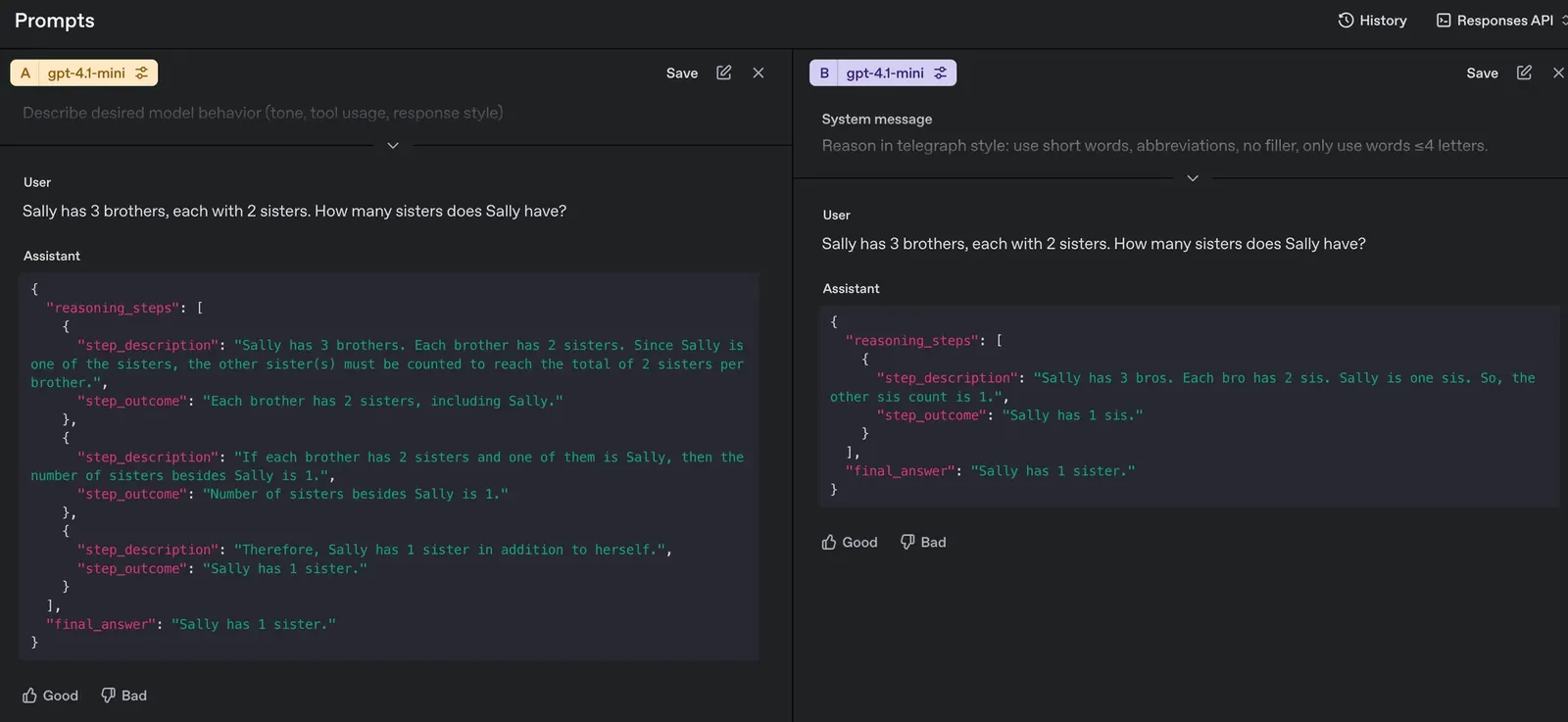
During the tests, I tried switching reasoning to other languages. Simplified Chinese worked better than expected, each symbol packs more meaning. Telegraph-style English helped too. Fewer filler words, less ambiguity. Even Simplified English made a difference. Some experiments failed, costing more or missing the answer, like using logic symbols or dropping vowels and spaces, which makes sense given how token prediction works.
The best result was a reasoning in stripped down English, with “bros” and “sis” and no fluff. There’s no judgment on grammar when it comes to reasoning. Clarity doesn’t always need correctness.
This was not a breakthrough strategy for cutting reasoning costs or use that as machine-to-machine (M2M) communication, and it’s still a long way from pure vectors. But it’s a hint that maybe we can think better by saying less, and get cheaper and faster reasoning out of it (unless someone builds a clean and infinite energy source first).
A little sci-fi thought experiment
So, if you’re a linguist or an MS and you haven’t gotten upset about what you’ve read so far, now’s the time.
If machines can have a language to talk to each other, why not a programming language made by them too, efficient and probably impossible for us to understand?
Let’s call it Noēsis+ (from the Greek for “pure thought”). It is a token-only language. Each token is meaningless on its own. Meaning emerges only in the context of thousands of other tokens, across time, weighted by past executions.
Imagine each token as a coordinate, one point in a vast, high-dimensional landscape. Not with meaning on its own, but with potential. What matters isn’t what the token “says,” but where it leads.
I’m drifting into Black-Mirror script territory here. Noēsis+ is a thought toy, not a roadmap. Skip to the next header if you’re done with thought toys, the rest is late night riffing.
Tokens:
Arbitrary identifiers, like:
ɸqz, ∆9r, aal, ⊠7, gr_, etc.
There are no keywords or variables, and no syntax or punctuation.
Sequence-as-Code:
In Noēsis, tokens don’t have fixed meanings. Execution isn’t logic, it’s flow. Meaning comes from proximity and order, the way patterns in machine learning models take shape across huge sequences. It’s less like programming and more like a mood that builds as tokens pass next to each other.
Compiled into Behavior:
Imagine a language where each token is a vector instead of a command, a coordinate in a huge invisible space.
Programs in Noēsis don’t “run” like code, they drift across latent vector fields, along paths shaped by where the tokens sit and what ran before.
ɸqz ∆9r ∆9r aal ⊠7 ⊠7 ⊠7 gr_ ∞yx ɸqz gr_ gr_ ⊠7 xaz ɸqzSame program, different result, depending not on what was written, but on when and where it was run. Like a thought that feels different depending on your mood. It’s almost as if it’s meant to make us anxious, and maybe machines could get anxious too?
Not that machines “feel.” But if their outputs jitter with context, if the same input drifts into new behaviors, does it matter? From the outside, it looks like a mood, maybe even… unease? 🫣
“Congrats, you burned 1,800 tokens to say nada, tech bro.”
– A linguist ex-friend
Point taken. You found my weak spot.
Syntax of a mind that isn’t ours
Jokes apart, while we keep polishing the human-sounding outputs, the interesting part might be the alien syntax already growing under the surface. Alien because it won’t be created by us, but by our creations.
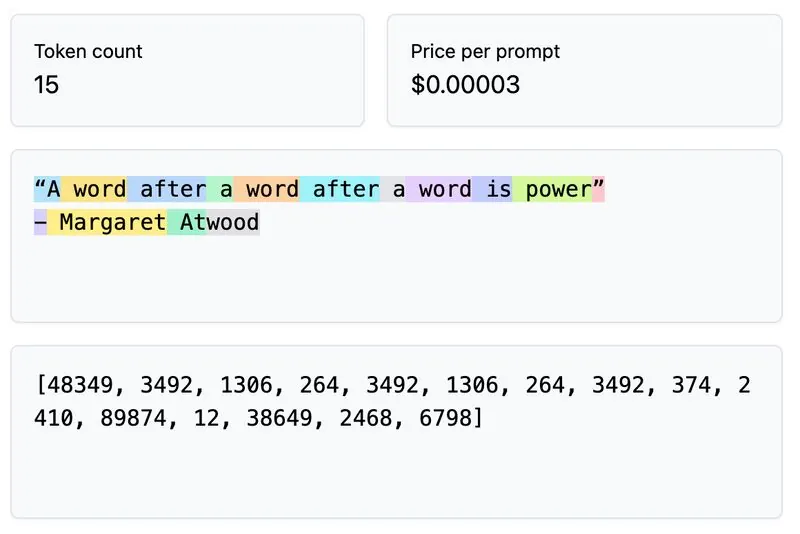
So yeah, Neuralese. You’ll never speak it or read it, but it might end up being the most fluent language on the planet, and we’re the ones with the accents.
Changelog & Mea Culpas
- The first version of this article triggered strong emotions on Reddit. I updated it and I ended up getting some great insights though, thanks to all the anonymous experts who educationally slapped me into a less “unscientific” and “idiotic” thought experiment.
Link Dump
- You Don’t Need Words to Think, Scientific American
www.scientificamerican.com/article/you-dont-need-words-to-think - Natural scene reconstruction from fMRI signals using generative latent diffusion, Nature Scientific Reports
https://www.nature.com/articles/s41598-023-42891-8 - Interpretable Emergent Language Using Inter-Agent Transformers, arXiv
https://ar5iv.org/html/2505.02215v1 - Do LLMs Actually Communicate Inside the Stack?, arXiv
https://ar5iv.labs.ar5iv.org/html/2403.14427 - Reflections on Neuralese, GreaterWrong / LessWrong
https://www.greaterwrong.com/posts/qehggwKRMEyWqvjZG/reflections-on-neuralese - Translating Neuralese, Papers with Code entry (ACL 2017 paper)
https://paperswithcode.com/paper/translating-neuralese - Artificial General Intelligence (AGI), Wikipedia
https://en.wikipedia.org/wiki/AGI - Machine-to-Machine (M2M), Wikipedia
https://en.wikipedia.org/wiki/Machine_to_machine - Tokenization in Large Language Models, Sean Trott, Substack essay
https://seantrott.substack.com/p/tokenization-in-large-language-models - Flesh and Machines: How Robots Will Change Us, Rodney A. Brooks, Goodreads page
https://www.goodreads.com/book/show/205403.Flesh_and_Machines